Angkor History: The Rise and Legacy of Cambodia's Ancient Empire
When you think of Angkor history, the rise and fall of one of Southeast Asia’s most powerful empires, centered around massive temple complexes like Angkor Wat. Also known as the Khmer Empire, it built cities bigger than modern London, with roads, reservoirs, and stone temples carved with stories that still speak today. This wasn’t just religion—it was power, engineering, and art fused into one. The empire lasted over 600 years, from the 9th to the 15th century, and at its peak, it ruled over much of what’s now Cambodia, Thailand, Laos, and parts of Vietnam.
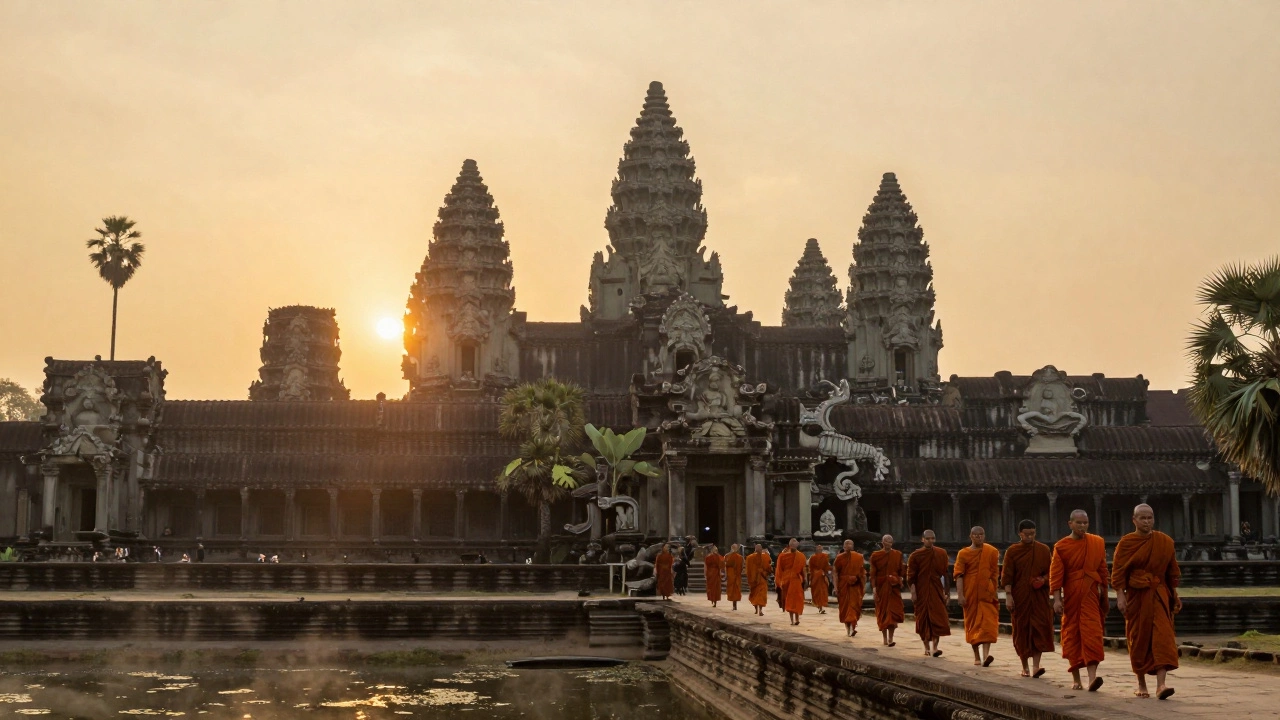
At the heart of this empire was Angkor Wat, the world’s largest religious monument, originally built as a Hindu temple dedicated to Vishnu, later transformed into a Buddhist site. Its five lotus-like towers rise like mountains, symbolizing Mount Meru—the center of the universe in Hindu and Buddhist cosmology. But Angkor Wat is just one piece. The region holds hundreds of temples: Bayon with its smiling stone faces, Ta Prohm swallowed by tree roots, Banteay Srei carved like jewelry in pink sandstone. Each tells a different chapter: kings claiming divine right, priests recording celestial events, artisans capturing daily life in stone.
What made Angkor so powerful? It wasn’t just armies—it was water. The Khmer built an advanced system of canals, barays (huge reservoirs), and moats that fed rice fields year-round, even during dry seasons. This allowed them to support over a million people, making it one of the most populous cities on Earth at the time. But when droughts hit in the 14th century and trade routes shifted, the empire slowly faded. The jungle took over. Temples collapsed. For centuries, Angkor was lost to the outside world—until French explorers rediscovered it in the 1860s.
Today, Angkor history isn’t just about ruins. It’s about how a civilization shaped by faith, climate, and innovation left behind something that still awes people centuries later. The carvings on the walls? They’re not decorations—they’re maps of ancient myths, records of battles, and prayers carved in stone. The temples weren’t just places to worship—they were centers of learning, administration, and identity.
What you’ll find in the posts below are real stories and insights tied to this legacy: how Angkor compares to India’s own temple cities, why travelers mix Angkor trips with visits to the Taj Mahal, how ancient engineering still inspires modern conservation, and what it’s really like to walk through these ruins at sunrise. This isn’t just history—it’s a living conversation between past and present, and you’re standing right in the middle of it.
- Dec, 1 2025
- 0 Comments
- Aaron Blackwood
Is Angkor Wat Buddhist or Hindu? The Real History Behind the Temple
Angkor Wat started as a Hindu temple dedicated to Vishnu but became a Buddhist site over time. Today, it's a living blend of both faiths, with Hindu carvings still visible alongside Buddhist worship.
Read More